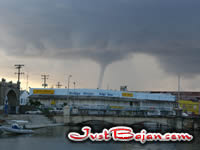
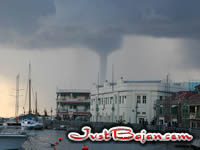
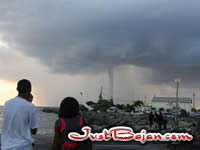
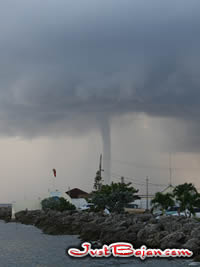
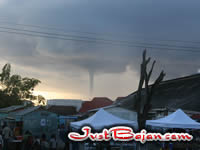
 I was in bridgetown Friday (23-Sep) evening when I noticed the clouds looked a bit strange. It's not everyday you see a funnel shaped cloud in Barbados. I noticed the funnel started to grow longer so I whipped out my camera ready for some action (note to self: Tornados are dangerous and you have no right trying to get closer... you should be heading for cover). I was in bridgetown Friday (23-Sep) evening when I noticed the clouds looked a bit strange. It's not everyday you see a funnel shaped cloud in Barbados. I noticed the funnel started to grow longer so I whipped out my camera ready for some action (note to self: Tornados are dangerous and you have no right trying to get closer... you should be heading for cover).
Since the funnel remained over the water, it's called Waterspout. I first notice the funnel forming around 5:15pm and ended around 5:27pm. Below is a waterspout's definition taken from Wikipedia, followed by some photos from Bridgetown. |
Waterspout
A waterspout is a tornado that occurs over water, usually not in association with a supercell thunderstorm. Although waterspouts are always tornadoes by definition, they are not counted in official tornado records unless they hit land. They are smaller and weaker than the most intense Great Plains tornadoes, but still can be quite dangerous. Waterspouts can overturn small boats, damage ships, do significant damage when hitting land, and kill people.
Tornados over water are usually quite dangerous, posing threats to ships, planes, and swimmers. It is recommended to keep a considerable distance from either of these phenomena, and to always be on alert through weather reports. The US National Weather Service will often issue special marine warnings when waterspouts are likely or have been sighted over coastal waters, or tornado warnings when waterspouts can move onshore.
Though they mostly occur in the tropics, they can seasonally appear in temperate areas. They are more frequent within 100 kilometers (62 miles) from the coast than out in the open sea. Waterspouts are common along the southeast U.S. coast -- especially off southern Florida and the Keys -- and can happen over seas, bays and lakes worldwide. |